Humans have an obsession with memory. Why do we need to secure the past in monumentally public form? (82)
Why do we crave these large markers of history in our public spaces?
The city is like a skin- empty space demands ornamentation. Graffiti inspires more graffiti. This phenomenon relates to how the government has used harsh tactics against graffiti and connects to the broken window theory and zero tolerance policies in the 80’s. But the same could be said for advertising in the public realm.
Grant’s tomb in NYC was so overridden by graffiti and vandalism it became a media symbol of urban decay.
In the 1970’s as an attempt to use public art as a solution, seventeen mosaic benches were installed. The colorful benches wrapped around the exterior of the building, providing a stark contrast to the austere mausoleum. Maybe this site was no longer relevant to the residents?! Space changes and needs to change for it to be useful to those inhabiting and for t not to feel like an untouchable museum. For graffiti artists, it becomes almost like a dare, to touch the pristine and the useless and to maybe make it relevant or to prove a point about it’s irrelevance. The irony is that it became used by the homeless as a dwelling place. Maybe the graffiti was trying to draw attention to the fact that the government cares more about the pristine nature and upkeep of a site for a dead man, though beloved, than it does for the health and safety of people living on the streets and so desperate that they are needing to use a grave for shelter.
Place Matters also discusses the debate and the role of public art. https://www.placematters.net/node/1365
Ephemeral art forms are often driven deeply by a cultural need to memorialize. Beyond examples of memorial walls, graffiti styled murals done in the spirit of roadside shrines in which countless cities have spawned into a kind of urban folk art. “Many artists have turned to the temporality of outdoor work as a medium to make the absence evident.” (82)
Ghost Bikes (2003) – death of bike riders hit by cars are given a creative and political symbol.
Ephemeral art forms are often driven deeply by a cultural need to memorialize. Beyond examples of memorial walls, graffiti styled murals done in the spirit of roadside shrines in which countless cities have spawned into a kind of urban folk art. “Many artists have turned to the temporality of outdoor work as a medium to make the absence evident.” (82)
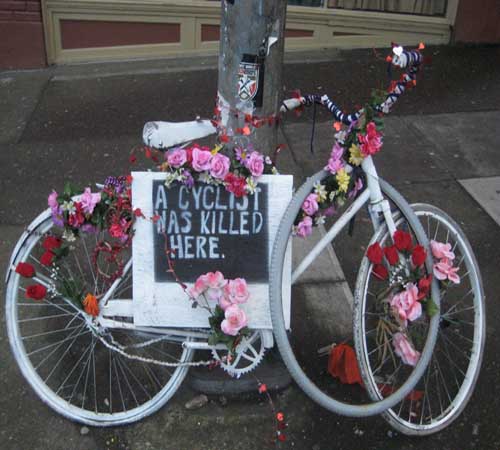
Ghost Bikes (2003) – death of bike riders hit by cars are given a creative and political symbol through the maintenance of a white bike at the fatal landmark. Here, the artists bring something that is not physical into physical space and the awareness of others. “Emotional regeneration is not a landmark, but a remark.” (83) This type of commentary gets written out by cities empiric process. People and places (whole realities) become eradicated and displaced.

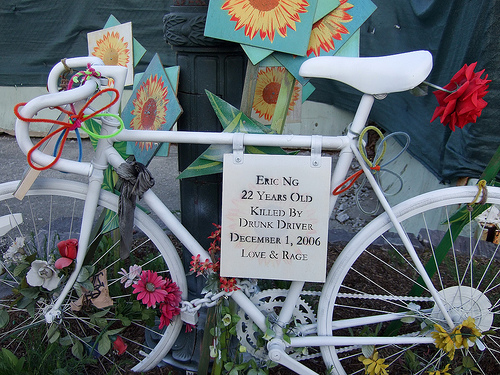
A guide to Portland Shrines – https://www.youtube.com/watch?v=kZNfFaVXh0A
A common goal of street artists is to make visible what has otherwise gone unnoticed and is fleeting in its disappearance.
“PEOPLE ARE THE FLOWERS THAT MUST SPRING THROUGH THE CRACKS IN THE DEHUMANIZED SIDEWALKS” (83)
This is my creed – connecting humanity, art making, combining street art with nature, the urge to fix what is broken and create.
 ART & BEA