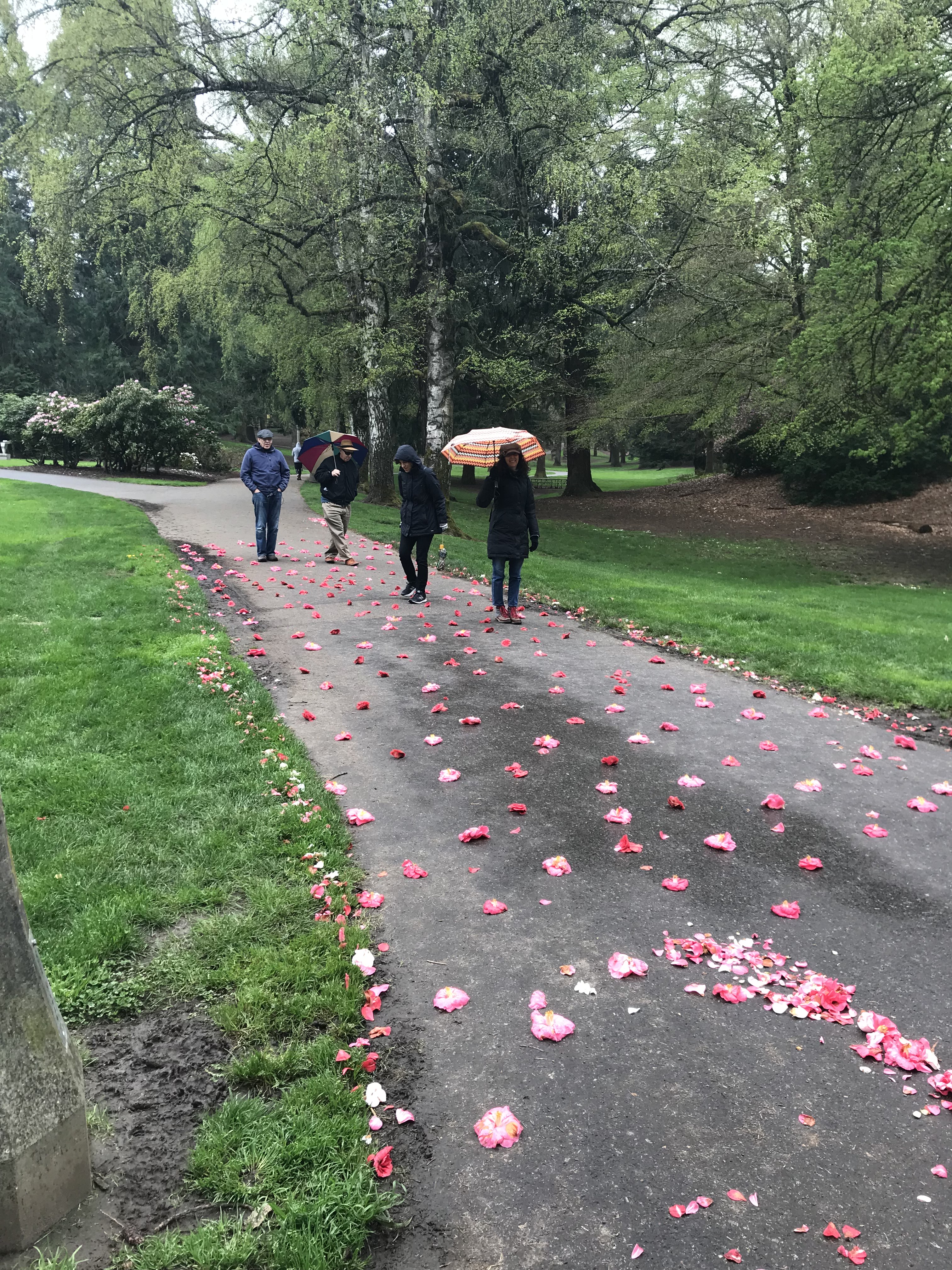
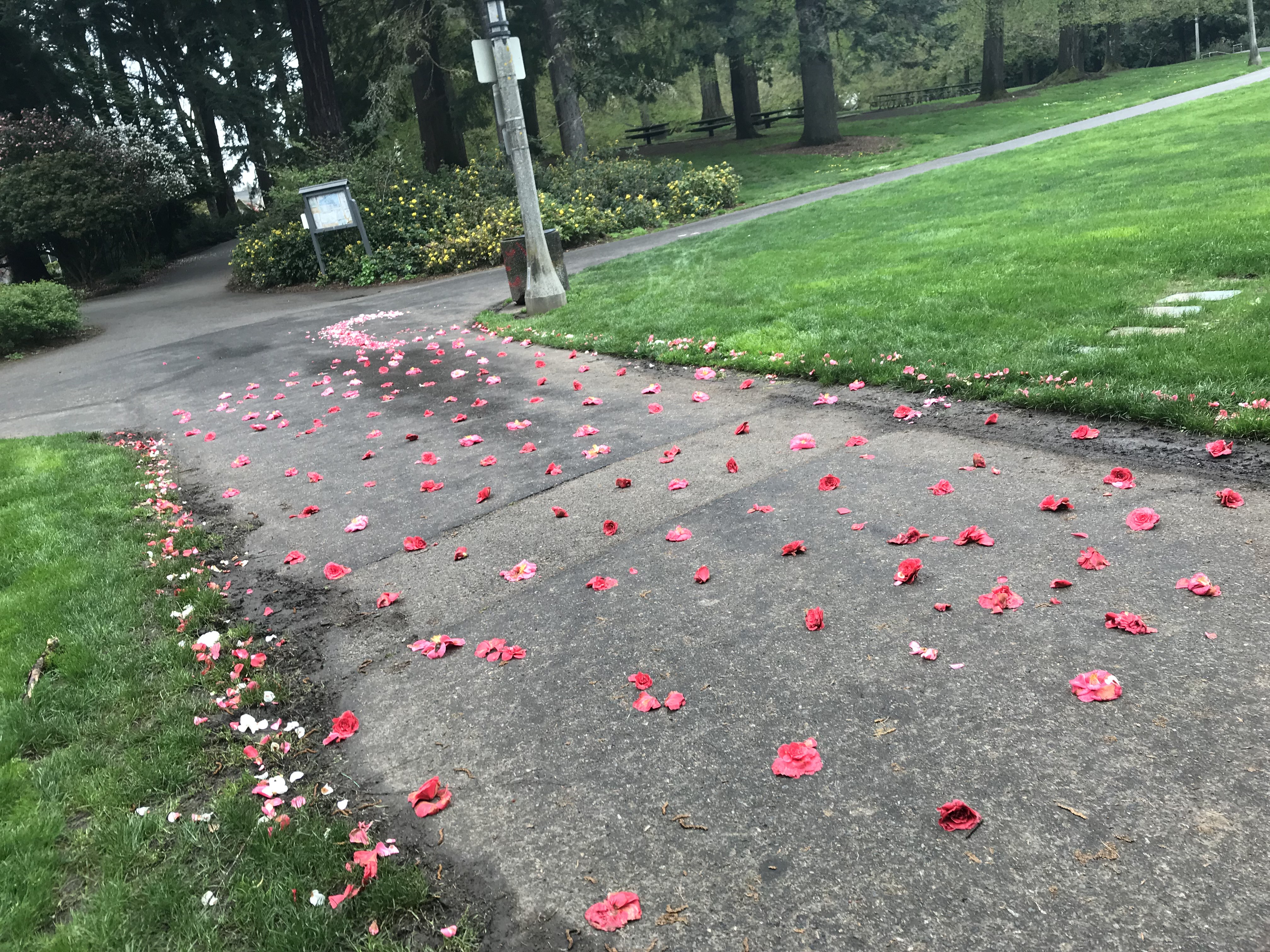
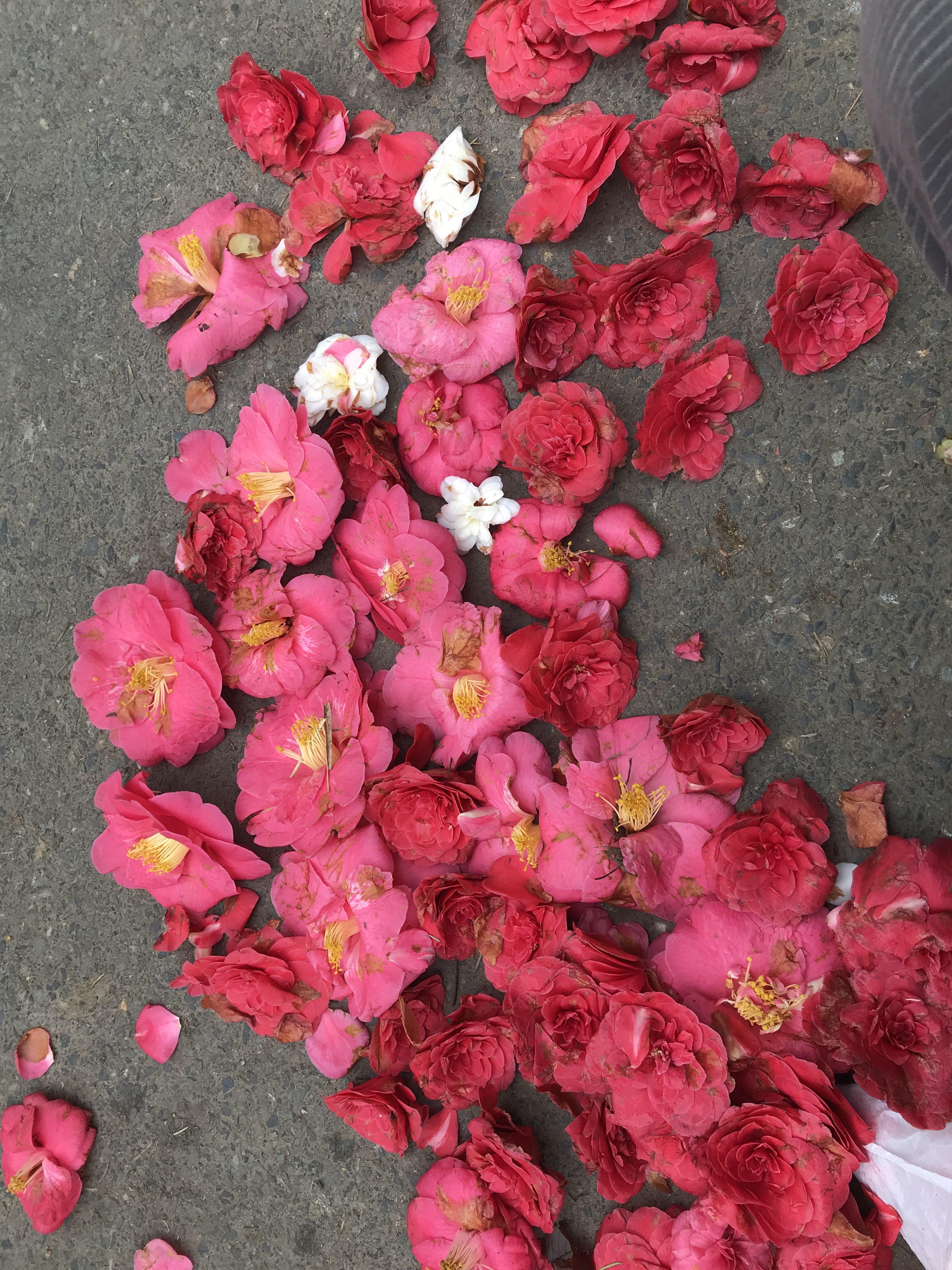
With the earth day celebration approaching at the non-profit pub, I was asked to create an eco-art pop-up event where people could come out and decorate the space a few days before the event to bring community and energy into the space with natural art making. I began collecting fallen camelia flowers in large garbage bags around the city to experiment with the medium and to see how long they last, and what kind of visual impact I could make with them. For this design in Laurelhurst park, I tried to incorporate as many ways of using the flowers and petals as possible. I made more planned, specifically spaced out orderly designs, petals sprinkled in the grass, on concrete, and then just messily placed paths. I ended up feeling that the mass of petals and flowers in a organic path packed the most punch from a distance and up close.
While creating the piece, so many people stopped to talk to me and ask me questions. Immediately I felt engaged and incorporated into connection with others and I felt there excitement and passion for art and beauty in the city. I was thanked more than a few times. I was moved by how many people engaged with me during the process. Exploring this type of work has made it even more clear to me that it is fundamentally about community and connection to space. Many people want to make, many want to be challenged to look at the spaces they utilize day to day in a different way, others just want to talk and ask questions.
Although City Repair has a huge emphasize on urban art projects, it is fundamentally about connecting people. It is not about the end result of a building project or kiosk or mural. The art is merely a tool utilized by the organization as one of the best connectors. I began at City Repair thinking there would be many artists and all sorts of techniques employed in the processes, I have found quite the opposite. The art is fairly rudimentary. The organization has information and knowledge about community process, planning and deciding on designs, and implementation with the city, but specific creations and imagery are almost the last on the list in what the organization focuses on.
I have noticed my approach with my own art making and how I facilitate projects at the organization begin to shift. I am less focused on end results, and more how the action feels, how the process is going, and who I am working with, and the spaces I am engaging. There is no right or wrong answers to doing this type of work. I am finding it challenging and freeing and different ways. It makes me wonder connect more to the concept of socially engaged art in Pablo Helguera’s book and the role of the artist and educator during the implementation of these projects. How can I be both the artist, educator, facilitator, activist during these actions? How can they be planned, small scale, off the cuff, with a classroom of students, or with a couple adults? What shifts? How do I become a dynamic facilitator?
 ART & BEA